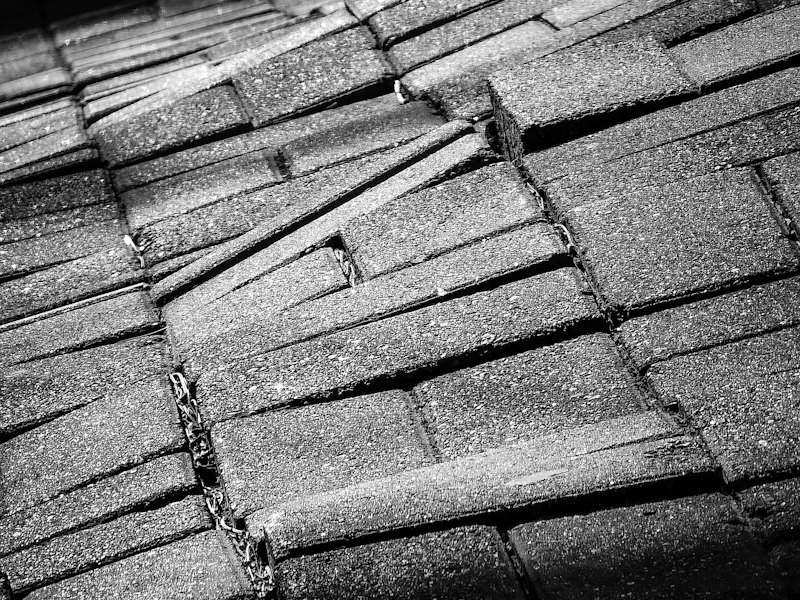
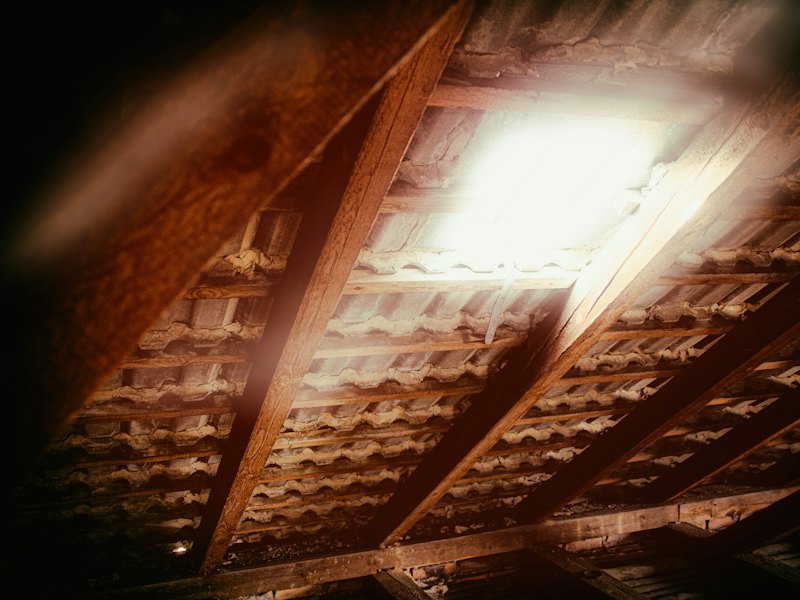
Tracing an active leak back to where water actually enters the roof, and repairing that, rather than sealing the spot where the ceiling happens to be wet.
Most leak calls arrive describing a stain, and the stain is the least informative thing about the problem. What narrows it fastest is the combination of which floor it appeared on, whether it tracks rainfall or appears in still weather, and whether it only happens when wind comes from one direction. Those three answers usually eliminate more than half the possible causes before anyone goes up.
The work is mostly elimination rather than discovery. There is a finite list of things that let water through a roof, and the job is ruling them out in the right order rather than guessing at the likeliest one.
Sealing where the ceiling is wet is the most common roof repair mistake and the most expensive one, because it hides the symptom while the decking underneath keeps getting wet.
The stain is evidence of where water left the structure, not where it arrived. We note it, photograph it, and then stop treating it as the location of the problem.
Water runs along rafters, purlins and the underside of decking before it drops. Following that path upslope from the stain gives a search zone on the roof rather than a guess.
Within the zone, the candidates are finite: penetrations, valleys, flashing laps, fastener backs-out, and the edge. Open field failures are far rarer than people expect.
A suspected entry point gets confirmed — usually by controlled wetting of one detail at a time — so that the repair is aimed at a known cause and not at the most plausible-looking one.
Once the cause is fixed, the decking around it is checked. Wet decking that gets closed up stays wet, and it will fail again from underneath.
Buildings this close leave narrow gaps that take roof water from both sides. A trace here usually starts at the side-wall flashing and the gutter run in that gap, before anything out on the open roof.
Reference point: the Gregory Avenue, Market Street and Eighth Street bridges across the Passaic River.
A borough this compact is almost entirely small lots with narrow side yards. Roofs drain into tight spaces, and rear additions -- very common on houses of this size -- add a low-slope section that behaves nothing like the main pitched roof above it.
Wallington is directly across the river from Passaic's east side, closer than much of Passaic is to itself.
Under a square mile of land carrying nearly twelve thousand people -- one of the most tightly built boroughs in the area, and one of the highest concentrations of Polish ancestry anywhere in the state.
All areas coveredUseful to know before accepting any quote, because a scope that ignores these is a scope that will have to change later.
New Jersey adopts a single Uniform Construction Code and municipalities may not set lesser or greater technical requirements. A repair specified correctly in Passaic is specified correctly in Clifton.
Replacing more than a quarter of a roof surface within any twelve-month period triggers a full construction permit. Splitting one job into two smaller ones inside that window does not avoid it.
Northern New Jersey sits in the design zone where an ice barrier is required, running from the eave edge to at least twenty-four inches inside the interior wall line. On older roofs it is frequently absent, which shows up as recurring winter leaks at the eaves.
In Passaic the Uniform Construction Code is enforced by the city's Division of Code Enforcement, which is where permits for qualifying roof work are issued.
The same job in the areas next door, and the other leak types we handle in this one.
Answers are general guidance about how these roofs behave, not a survey of any particular building.
Because water almost never enters directly above where it appears. It runs along decking and framing first. Sealing the visible spot hides the symptom while the decking above it stays wet.
Buildings sit close enough that the work usually happens from the gap between them or over a side gate. Whether that gap is clear, and who controls it, often decides how quickly the roof can be examined.
Only if more than a quarter of the roof surface is replaced within a twelve-month period — that is the threshold under the New Jersey Uniform Construction Code. Most targeted leak repairs sit well under it, but the scope decides, not the label on the job.
Describe what you are seeing and when it started — that is usually enough to narrow the cause before anyone climbs anything.